
Myth # 1: If you find a fawn alone, she has been orphaned.
Fact: It is quite common to see fawns alone. The babies, lacking any scent to attract predators and incapable of keeping up with the doe in dangerous situations, are essentially “parked” in various (quite often, peculiar) locations. The doe will visit the fawn two to three times a day.Until the fawn is four weeks old, you will rarely see it with the mother. Instead, the fawn relies on camouflage and lying still for protection during this vulnerable period. It’s always best to leave fawns alone unless you know with certainty that the mother is dead and/or fawns are crying incessantly.
Myth #2: Baby bunnies have been abandoned.
Fact: Mother rabbits only visit the babies 2-3 times per day to avoid attracting predators. If the nest is intact and there are no visible wounds, remove any pets and leave them there. When the eyes are open and they’re as big as the palm of your hand, they are independent. Mother rabbits are very sensitive to human scent so if you put a baby back, just use a clean towel to remove any odor. Rabbits breed between February and September with a 28 day gestation period. Consequently, three to four litters of four to five babies are born each year.
Myth # 3: If you touch a baby bird, the parents will abandon him/her.
Fact: Birds have a limited sense of smell, but are strongly bonded to their chicks. Parents will not abandon chicks handled by humans. The best thing humans can do if a baby bird falls from its nest, and is not well feathered and clearly learning how to fly, is to put him back in the nest. The parents will return to feed him. If the nest is destroyed, you can use a basket or a Cool Whip container. Simply punch holes in the bottom (to avoid drowning the babies when it rains), line the container with grass or the remaining nest, and tack up into the tree. (Be sure the container is not too deep as the parents are reluctant to fly into anything they can’t see out of.)
Myth #4: Feeding bread to geese and ducks is okay.
Fact: Bread is bad for all birds because it offers little nutritional value. Severe health problems, including a debilitating condition called “Angel Wing” can be caused by bread diets. Feeding can also lead to dependency in ducklings and goslings who fail to learn how to find native foods on their own. Some birds can even become aggressive about being fed which often leads to a tragic outcome if humans decide to remove them.
Myth # 5: Canada geese stick around because they forgot how to migrate.
Fact: Geese who live in one place year-round do so through no fault of their own. Our “resident” birds are descendants of captive-bred geese introduced by wildlife agencies over several decades to restore “huntable” populations. Geese were also released by people who thought they would simply look nice on their ponds. As a result, transplanted geese never learned to migrate from their parents, but still thrive in our suburban landscapes.
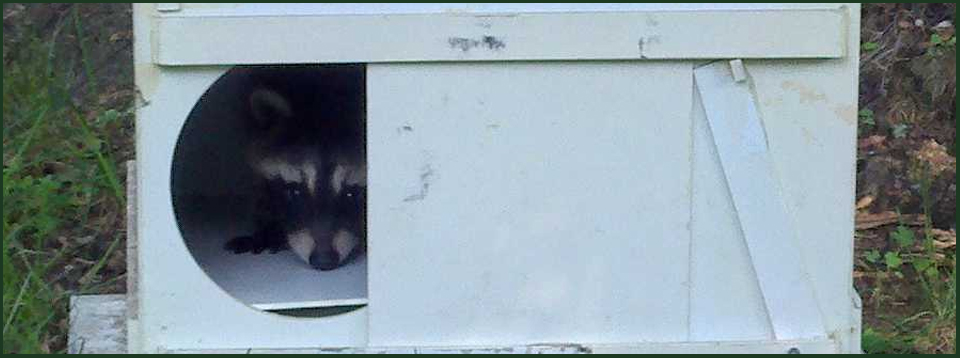
Myth # 6: If you see a raccoon during the day, he must be rabid.
Fact: Raccoons are opportunistic and will appear whenever food is around. Although normally nocturnal, it is not uncommon to see them during the day foraging for food, especially in spring and summer when the mother’s energy levels are depleted by nursing cubs.However, if the animal is acting disoriented or sick, such as circling, staggering or screeching — in addition to being seen during daylight hours — contact a wildlife rehabilitator or local animal control officer.
Myth #7: If you get close to a skunk, you’ll get sprayed.
Fact: It is actually pretty difficult for a person to get sprayed by a skunk. These animals only spray to defend themselves, such as when a dog runs up and grabs them. Skunks cannot “reload” quickly and do not waste their odiferous weapon unless necessary. Instead, they will stamp their front feet as a warning to get you to back off. Skunks are also quite nearsighted so if one is encountered, simply talk softly and back away.
Myth # 8: Bats get tangled up in your hair if they fly near you.
Fact: The last place a bat wants to be is in your hair. Bats navigate using a complex sonar-like system called echolocation which allows them to “see” their world with precision. The misconception about bats flying in hair is based on a bat’s swooping flight patterns when trapped in a confined space, like a house. The reason they swoop is not to fly into your hair, but to stay airborne.
Myth #9: Opossums are vicious and rabid.
Fact: Opossums are the only marsupials North of Mexico and have more teeth (50 of them) than any other mammal in North America. The average female lives only about a year. Opossums are highly resistant to rabies, most likely due to their low body temperature. Opossums are also relatively benign creatures that defend themselves by hissing, teeth-baring, and drooling. These are not a sign of rabies but rather a bluff to scare off potential predators. When their act doesn’t work, they play dead.
Myth #10: Live trapping and relocating wild animals is humane.
Fact: The majority of relocated territorial mammals do not survive. In fact, in some states, it is illegal for people to relocate an animal. Additionally, live-trapping can be indiscriminate and often fails to target the “nuisance” animal. Baiting a trap also attracts other animals to any given area – even those animals that don’t typically frequent that location. Equally important, this practice results in the orphaning of youngsters that succumb to starvation or predation.
Wild Neighbors: The Humane Approach to Living with Wildlife (December 2007, Humane Society Press) is a useful reference for individuals and communities faced with resolving encounters with wild animals who find their way into yards, gardens, houses, parks and playgrounds. On the web humanesociety.org/wildneighbors
SIGN UP FOR OUR NEWS ALERTS
Know what's going on


Please contribute today and help make a difference.